Russian fishery tycoon, who sues Norway, seeks Arctic sway
Since the start of Russia’s full-scale war against Ukraine, Vitaly Orlov has acquired several shipyards, built seaports, and expanded fish processing—and now he eyes a key role in expanding Arctic trade.

Notice to readers: this article was updated on 5 October 2026 at 10:56. The updated article includes responses to questions addressed to Norebo.
When Vladimir Putin visited Kamchatka, in Russia’s Far East, in early September 2022, he held a video conference in which a top representative of Norebo was given five minutes of speaking time.
At the meeting, Vladimir Valter, who heads Norebo’s logistics department, outlined how the company is building port infrastructure, shipyards, and fish processing plants.
“The Norebo Group is actively implementing investment projects in the Far East and the North-West aimed at developing port infrastructure, specifically the construction of terminals—notably in Petropavlovsk-Kamchatsky and Murmansk—which connect the two endpoints of the Northern Sea Route,“ he told Putin.
However, more support is needed, Valter emphasised. He explicitly called for favourable long-term financing for the company’s ship repair yard on Kamchatka.
Vladimir Putin expressed his full support for Norebo.
“I believe this is a very important priority,” he said. “We’ll do our very best to support you,” he added.

Norebo is Russia’s most powerful fishery company. It is owned and managed by Vitaly Orlov, the richest man in the Russian fishing industry, with a net worth of €1.2 billion, according to Forbes (2026).
Orlov has built his fishery empire since the 1990s—initially together with partners Magnus Roth and Aleksandr Tugushev, and since 2016 as the 100 percent owner of the company.
Over the years, an estimated $600 million has been invested in numerous company acquisitions, according to Forbes. Norebo Holding, the parent company, now operates at least 15 companies.

Since the start of Russia’s full-scale war against Ukraine, Orlov has expanded significantly within port development and shipbuilding.
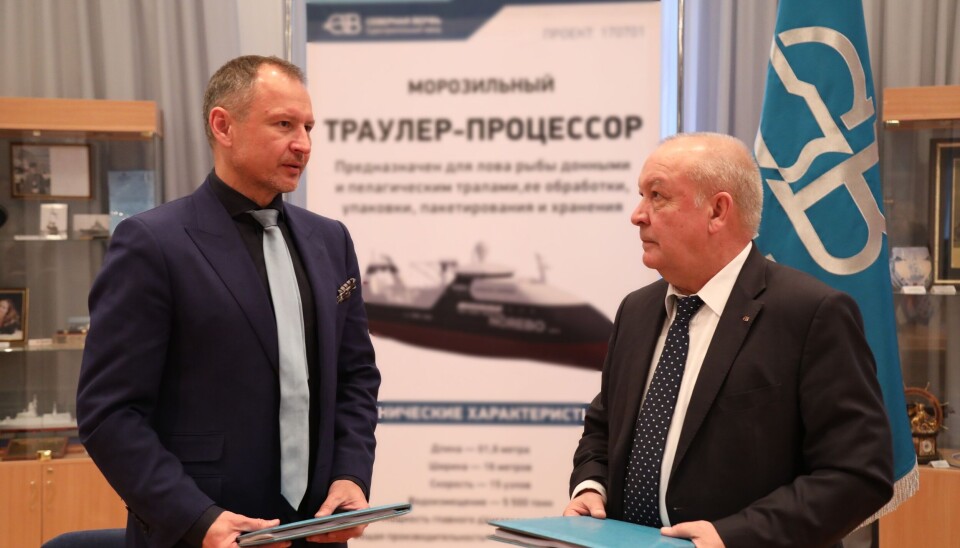
In 2022 alone, he bought two shipyards in St Petersburg and the Leningrad region. The Neva-Stapel and Otradnoye shipyards have enabled Norebo to expand the construction of new trawlers and reefers.

On Kamchatka, Orlov is investing heavily in the Seroglazka terminal, which is reported to have the capacity to handle up to one million tonnes of container cargo per year by 2027.
In Minkino, outside Murmansk, Orlov’s new Udarnik terminal reportedly has the capacity to handle 800,000 tonnes of container cargo. It has been developed to serve traffic on the Northern Sea Route, the company reports.
Leading representatives of the Russian government and the Kremlin have been regular guests at Orlov’s facilities.
In September 2024, Putin’s plenipotentiary for Northwest Russia, Aleksandr Gutsan, paid a visit to the Udarnik terminal in Minkino. He was accompanied by Governor Andrei Chibis and Vladimir Grigoriev, director of Norebo Holding, a local newspaper reported.

In December 2023, Governor Chibis accompanied federal Minister of Industry and Trade Denis Manturov on a visit to the Otradnoye yard in St Petersburg.
In December 2021, Yuri Trutnev, Russian Deputy Prime Minister and Putin’s plenipotentiary in the Far East, visited Norebo’s ship repair plant in Kamchatka. Photos from the visit show Trutnev together with Vitaly Orlov and Vladimir Valter, as well as Minister for the Far East and Arctic Aleksei Chekunkov and regional governor Vladimir Solovyev.
The new shipyards controlled by Vitaly Orlov allow him to benefit from a generous federal support scheme for the shipbuilding industry. The so-called Programme for Investment Quotas has been designed to help boost the construction of Russian-made trawlers.
According to Ilya Shestyakov, head of Russia’s Fishery Agency, 48 vessels had been built as part of the programme by November 2025. Of these, 25 were fishing vessels and 23 were crab-fishing vessels, he said in a meeting with Vladimir Putin. In addition, 30 fish processing plants were built in that period. According to Shestyakov, another 24 vessels—13 fishing vessels and 11 crab-fishing vessels—will be built in 2026.

Vitaly Orlov’s shipyards account for a significant share of the new vessels. Reportedly, at least 12 ships were under construction at the two yards in St Petersburg in late 2023.
Putin has repeatedly expressed support for the fishing industry.
“I am confident that the Russian fishing industry—despite all external challenges and attempts to exert pressure through sanctions—will continue to develop steadily and enhance its competitiveness. And the state will certainly provide companies and their workforces with the necessary support to tackle their priority tasks,” he said in July 2022.
The comment was made as Putin attended the commissioning ceremony for three new trawlers in St Petersburg, among them Norebo’s Kapitan Sokolov.

According to investigative journalists at the Dossier Centre, Vitaly Orlov and his Norebo are linked with people close to the Kremlin. Reportedly, lawyer Nikolai Yegorov, a former classmate of Vladimir Putin, has helped Orlov obtain major loans from state bank Sberbank. According to Dossier, Sberbank has granted Norebo loans amounting to almost one and a half times the value of the group itself. This is what has allowed Norebo to continue its aggressive expansion, the investigation concludes.

When requesting a comment from Norebo, the journalists from Dossier, all of them living in exile, were told that they would get answers only if they came in person to the company’s Murmansk office
The close relations between Norebo and the Russian authorities have backfired following the war of aggression against Ukraine and Russia’s mounting hostile activities aimed at neighbouring countries.
In May 2025, the company was added to the EU’s sanctions list for alleged involvement in intelligence activities.
According to the EU Council, Norebo’s vessels are involved in espionage.
“The movement patterns [of Norebo’s vessels] have been linked, including by Member States and the authorities of third states, to the Russian state-sponsored surveillance campaign that employs inter alia civilian fishing trawlers to conduct espionage missions directed against civilian and military infrastructure in the North and Baltic Seas. Those activities can facilitate future sabotage operations. […] Norebo JSC has also received several loans from Sberbank, a Russian state-owned bank.”
In July 2025, Norway followed suit with the EU and sanctioned Norebo, a move that effectively banned the company from Norwegian ports and waters.
Norebo subsequently took the Norwegian state to court. In addition, the company has threatened Norwegian newspapers, among them Fiskeribladet and the Barents Observer, over their coverage of the company.
*
In connection with this article, the Barents Observer has sent several questions to Norebo. We requested feedback on the company’s plans for shipments on the Northern Sea Route and the building of new trawlers, the alleged relationship between Vitaly Orlov and lawyer Nikolai Yegorov, and the effects of international sanctions on company activities. We also requested a comment on Norebo’s lawsuit against the Norwegian state, as well as threats against Norwegian media companies.
Norebo’s lawyer Michael Lewis at Devonshire Solicitors, London, UK, sent a response to the questions on 2 October at 18:34.
Lewis emphasises that Norebo did not get sufficient time to respond to the questions before the article was published.
Regarding shipments on the Northern Sea Route, Lewis writes:
Norebo is a fishing and seafood business. Long-distance shipping is the business of independent third parties, not Norebo. Developing infrastructure which serves the seafood trade is distinct from operating a long-distance shipping service. Your article should make that distinction clear.
Regarding ice-class capabilities of the new trawlers, Lewis writes:
Norebo’s new trawlers have ice-class specifications comparable to those of similar commercial fishing vessels operated by Norwegian, Icelandic, Faroese and other European companies. They are fishing vessels, not icebreakers. Their specifications are intended for safe commercial fishing operations.
Regarding the alleged relationship between Vitaly Orlov and Nikolai Yegorov, Lewis writes:
That allegation is false. Mr Orlov has no relationship with Mr Yegorov of the kind alleged. Mr Yegorov did not procure or facilitate Norebo’s Sberbank financing. He has no direct, indirect or informal ownership interest in Norebo.
Norebo’s Sberbank loans were ordinary commercial loans obtained on arm’s-length terms. They were not secured through Mr Yegorov or political patronage. Neither Norebo nor Mr Orlov has any personal, political or financial relationship with President Putin. Norebo is wholly privately owned. The suggestion that its commercial expansion resulted from the political patronage alleged in your article is wrong.
Lewis strongly rebuffs the information published by Dossier Centre, a source referred to in the article:
Dossier’s associated allegation that Mr Yegorov held an informal 10% interest in Norebo is also false. Dossier expressly acknowledged that their source provided no documents supporting that alleged interest. That unevidenced allegation cannot therefore be relied on as evidence to corroborate your assertion that Mr Yegorov secured Norebo’s financing.
Regarding affects of international sanctions on company activities, Lewis writes:
For the avoidance of doubt, those sanctions do not require Norebo to cease operating worldwide. They restrict dealings involving persons, companies and activities within the jurisdiction of the relevant regimes. Norebo is focused on the domestic market, supplying nutritious seafood to Russian consumers. It continues to challenge the sanctions through the appropriate legal procedures.
He strongly rebuffs information about Norebo’s alleged involvement in intelligence activities.
Your article repeats allegations that Norebo’s vessels conduct espionage for the Russian state and that those activities could facilitate future sabotage. Those allegations are false. Norebo does not conduct espionage, and its vessels have not been used for the alleged state-sponsored surveillance or to facilitate sabotage. Norebo is challenging the sanctions imposed on the basis of those allegations.
Regarding the lawsuit against the Norwegian state, he writes:
Your article states that Norebo took the Norwegian state to court, while the headline describes Mr Orlov as suing Norway. The proceedings were brought by Norebo group companies, not Mr Orlov personally.
The report linked in your article concerns an application for an interim injunction relating to fishing licences. That application is distinct from the substantive proceedings. The two should not be conflated.
Regarding threats against Norwegian media companies, he writes:
Your article states that Norebo “has threatened Norwegian newspapers”, including Fiskeribladet and the Barents Observer. That description obscures both the nature of the legal steps taken and the reasons for them.
Fiskeribladet received formal pre-action correspondence identifying specific allegations which are false, defamatory and materially misleading. The letter explained the complaint, sought remedies and stated that proceedings might follow if the complaint was not resolved.
In relation to the Barents Observer, Mr Orlov has already issued and served proceedings. This is not merely a threat by Norebo to sue.
Norebo has no objection to accurate reporting of sanctions or legitimate criticism. Its objection is to false allegations and to the presentation of general claims about Russian fishing vessels as evidence against Norebo without a Norebo-specific factual basis. Seeking correction and, where necessary, pursuing legal remedies is not an attempt to prevent legitimate journalism